Dharmapuri package
Pick up from your hotel or house we going to Visit Kattu Veera Anjaneyar Temple at morning. Get the blessing and enjoy the beautiful scenic view of the city. Have tiffen nearby and do shopping at famous shops. we have go to kalabairavar temple Then ,Afternoon visit Sri Raghavendra Temple ,have lunch at authentic veg restaurants at good hotels and spend your afternoon time at temple. Finally, visit to Mahalingeshwara shiva temple drop your hotel or house
1.Kattu Veera Anjaneyar Temple :
The Kattu Veera Anjaneyar Temple, located in Dharmapuri, Tamil Nadu, is a notable temple dedicated to Lord Hanuman, also known as Anjaneyar.The Kattu Veera Anjaneyar Temple is relatively modern compared to some ancient temples, but it has quickly gained prominence among devotees. The temple's exact date of establishment is not well-documented, but it has become an important religious center in Dharmapuri.The temple's name, "Kattu Veera Anjaneyar," translates to "The Brave Anjaneyar of the Forest." This name signifies Lord Hanuman's association with bravery and strength, as well as his connection with the forest. The temple is believed to be built to honor Lord Hanuman’s qualities and to provide a place of worship for his devotees. The temple features traditional South Indian temple architecture, with a prominent gopuram (gateway tower) and a spacious sanctum (garbhagriha).The Kattu Veera Anjaneyar Temple celebrates several important festivals, with Hanuman Jayanti being the most significant. Hanuman Jayanti marks the birth of Lord Hanuman and is celebrated with special poojas, processions, and devotional activities. Other festivals like Rama Navami and Deepavali are also observed with enthusiasm.he temple is a symbol of devotion and strength in the local culture. It represents the deep reverence for Lord Hanuman and the values associated with him, such as loyalty, courage, and selfless service.
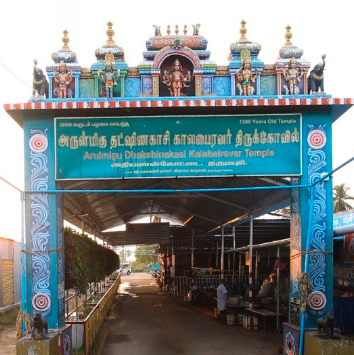
2.kalabairavar temple :
Kalabairavar, also known as Bhairava, is a form of Lord Shiva who is often depicted as a fearsome deity associated with time and cosmic dissolution. According to Hindu mythology, Bhairava is a guardian of the eight directions and is believed to have emerged to protect and uphold Dharma. The temples dedicated to Kalabairavar are often built at significant sites where he is believed to have appeared or performed divine acts.Kalabairavar is revered as a powerful and fearsome form of Lord Shiva. He is often depicted with a fierce countenance, a garland of skulls, and holding weapons. Kalabairavar is associated with time (Kala) and is considered the protector of devotees against the fear of time and death. Worshiping Kalabairavar is believed to bring spiritual strength and protection from negative influences.Kalabairavar is revered as a powerful and fearsome form of Lord Shiva. He is often depicted with a fierce countenance, a garland of skulls, and holding weapons. Kalabairavar is associated with time (Kala) and is considered the protector of devotees against the fear of time and death. Worshiping Kalabairavar is believed to bring spiritual strength and protection from negative influences.
3.Sri Raghavendra Temple :
The Sri Raghavendra Temple, dedicated to Sri Raghavendra Swamy, is a revered shrine honoring the life and teachings of the 16th-century saint and philosopher. Sri Raghavendra Swamy was born on 27th December 1595 in the village of Bhuvanahalli, near Chitradurga in present-day Karnataka. He was a prominent disciple of the Madhva tradition and is known for his deep scholarship, devotion, and miracles. He is revered as an incarnation of Vayu, the divine wind deity, and is highly respected for his contributions to spiritual and philosophical thought.Sri Raghavendra Swamy is known for numerous miracles and divine acts, which have contributed to his widespread veneration. His life was marked by simplicity, devotion, and a commitment to spreading the teachings of the Dvaita philosophy. His final resting place, the Raghavendra Swamy Mutt in Mantralayam, is a major pilgrimage site.Temples dedicated to Sri Raghavendra Swamy typically feature traditional South Indian temple architecture with a focus on simplicity and devotion. The architecture may include a gopuram (gateway tower), a sanctum (garbhagriha) housing the deity, and various halls and prayer spaces.
4.Mahalingeshwara shiva temple :
The Mahalingeshwara Shiva Temple, located in various regions across South India, is dedicated to Lord Shiva, who is worshipped here in his form as Mahalingeshwara. The Mahalingeshwara Shiva Temple is often associated with ancient traditions of Shiva worship. The deity Mahalingeshwara represents one of the grand forms of Lord Shiva, embodying the essence of the Linga, which is a symbol of cosmic energy and creation. Legends associated with Mahalingeshwara often involve stories of Shiva's divine presence and his role in cosmic activities.Mahalingeshwara is a form of Lord Shiva depicted in the Linga form, which symbolizes the infinite and formless aspect of the divine. The Linga is often represented as a cylindrical stone or pillar, symbolizing the eternal and omnipresent nature of Lord Shiva. Worship of Mahalingeshwara emphasizes the abstract and universal aspects of divinity.Mahashivaratri, the great night of Lord Shiva, is a major festival observed with elaborate poojas, fasting, and vigils. Other festivals such as Shivaratri, Karthigai Deepam, and Sivaratri are also celebrated with devotion and grandeur.The worship of Mahalingeshwara has a significant impact on South Indian culture, particularly within the context of Shaivism. The Linga form of Shiva is an essential element of religious practice and symbolism in Hinduism.